Tomatoes…and introducing our new pasture management team.

Five hair sheep in a paddock at ARTfarm
ARTfarm welcomes the newest members of our Pasture Management Team: Sleepy, Coco, Yooyoo, Nobby, and Whoopsie. These local hair sheep are Dorper, St. Croix White and Brazilian Nova mixes.

We are now at the point in the season where we put up the giant “TOMATOES” sign, and you’ll start to see our cherry tomatoes in local fine dining establishments!

Saturday morning’s stand will also include fresh microgreens, sweet mix, spicy mix, teen spicy, a plethora of varied cooking greens, herbs including some new ones for this season (sage! holy basil!) and your old favorites (delfino cilantro, italian, lemon and thai basils, thyme, caribbean oregano, lemongrass, garlic chives, and giant scallions!)…cucumbers, lettuce heads, and of course giant zinnia flowers, chocolates and a few baked treats!

Please call or let us know at the stand,  if you’d like to special order fresh local meats: chicken (half or whole), lamb or goat (leg, roast, cut for stew).

ARTfarm gift certificates are beautiful and make a thoughtful gift.

And in other exciting farm news, our Livestock Manager has acquired five experienced new employees (pictured above) who are charged with improving our pastures and keeping things nicely trimmed around the farm. Please join us in welcoming Coco, Sleepy, Yooyoo, Whoopsie and Nobby. They’re all expecting! Christina plans to bring them out to visit at the farmstand after they’ve had a chance to get accustomed to their new home and the staff.

Come visit the ARTfarm!

ARTfarm Closing for a Quick End-Of-Summer Break…

This morning’s farmstand was our last for a few weeks. We’ve got to focus our full attention on some big projects, to make the farm more productive and sustainable in the coming seasons.

We’ll reopen in mid-October with a new rainwater catchment pond, some new signs, some new artwork in the ARTbarn and sheep grazing in our pastures! We’re seeding many crops for this coming fall and winter’s harvest now, starting a new batch of native trees from seed, and playing with a few experimental crops including local roasting corn and fig trees. Stay tuned for updates.

Three workers in a large Mars-like crater shovel rocks into the bucket of a skid steer at ARTfarm.
Three awesome ARTfarm workers - Tucker Brown, Eric Gautreau and Adrian Jordaan - in a large Mars-like crater, shovel rocks into the bucket of a skid steer in preparation for the lining of a rainwater catchment pond.

If you have some time to spare or know anyone with an interest in and enthusiasm for sustainable farming, we are always looking for reliable nonsmoking volunteers and workers who’d like to help out and learn something new. (It’s not ALL shovelling rocks!) Give us a call at (340)514-4873 or pass our website along to those who might be interested: artfarmLLC.com.

Laying Pipe

In the off season, when the tomatoes are NOT bursting off the vines, you’d think we would take it easy, go to the beach, or do some cool new paintings.

Not so, friends.

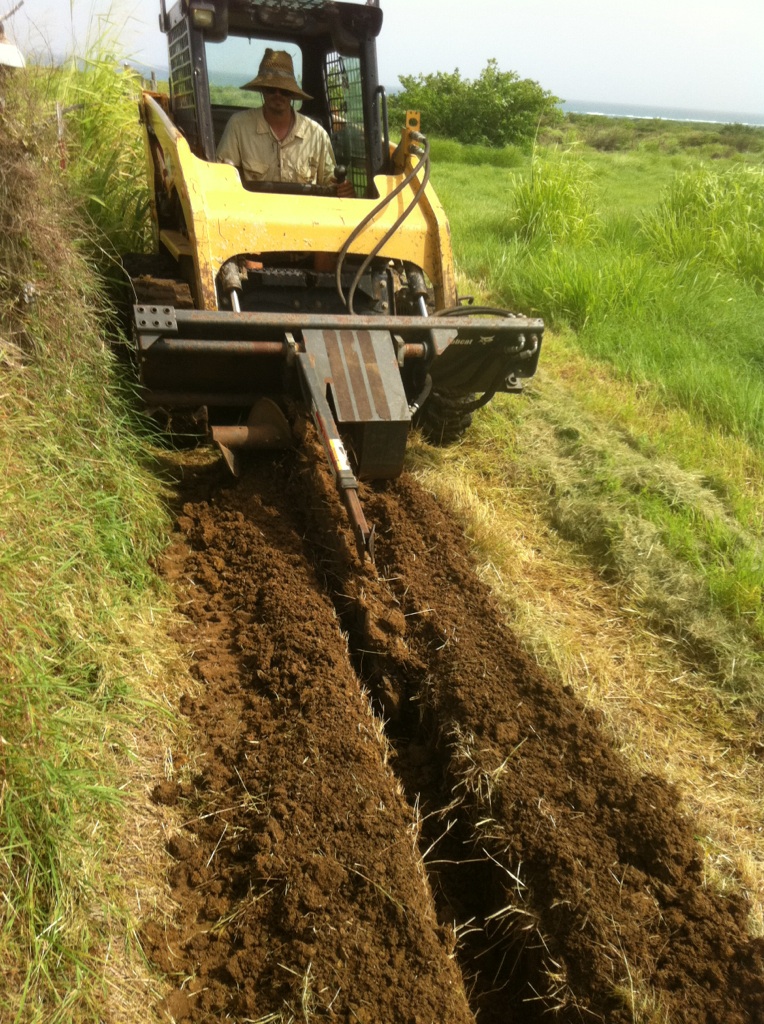
Luca operating a trencher on a skid steer in the pastures at ARTfarm
Luca operating a trencher on a skid steer in the pastures at ARTfarm. We're laying poly pipe for livestock irrigation! Photo by Mitch Amarando.

The off season is when we catch up on infrastructure projects. Luca has been cutting trenches with a skid steer using a hydraulic trenching attachment in our pastures, to bury water lines for our upcoming livestock project. We’ll be experimenting with multi-species grazing and micropasturing. We’re burying the polyethelene pipe so that it will be protected from UV damage, heavy equipment, fire, and chewing animals. It should last just about forever.

Beeeeeee Sunday!

With all the fantastic rain and blooming flowers and growth it is swarming season for bees that have outgrown their hives.

A swarm in May is worth a bale of hay.
A swarm in June is worth a silver spoon.
A swarm in July isn’t worth a fly.

Over the last two days we observed a group of about 20-30 bees actively investigating various structures around the farm. They were curious but not aggressive or interested in us. (Bees are very singular in purpose. When they are scouting, they are not looking to sting anyone. They look scary as they swoop about in large groups, buzzing loudly, but since they are not defending their home, they won’t sting unless someone is swatting at them, crushes one, or shows aggression toward them.)

This morning the same smallish group of 20-30 bees was spotted scoping out a space above the back kitchen door of one of the historical buildings on the property. Within ten minutes, a deafening hum could be heard as literally thousands of bees descended and began moving into a 1/2 inch crack near a roof beam at the same location.

Christina called our beekeeper, Wanda of Wright Apiary, for assistance and the two ladies donned bee suits and were able to pry up a small piece of plywood covering the hollow space in the roof structure, and gently vacuum the extremely large and healthy swarm out of the inside of the roof and into two small cages using special beekeeping tools. A bit of smoke from a hive smoker along a crack in the wall encouraged most of the rest of the bees to come back out from the deep recesses of the roof structure.

About halfway through the removal process Wanda was skilled enough to spot the large queen and capture her in a special queen box. Wanda installed the queen, in her cage, into a temporary small hive box and we began the process of gently shaking and brushing pounds and pounds of buzzing bees from the now heavy small cages into the small hive box. Lastly, Wanda placed a bit of bee food in the hive box to help them feel invested in their new location.

The hive box will remain near the hole in the roof for a few days until the rest of the bees have found their queen. Then we’ll move them into a larger hive box with a comb or two of ‘brood comb’ where the queen, once released from her cage, can immediately start laying her eggs. This should encourage the bees to stay in the new hive, even though it wasn’t their first choice.

If you spot bees swarming around your yard or home, don’t panic. Bees that are out and about looking for a place to live are focussed on the move and are not looking to sting people. A large swarm hanging off a tree can look like an odd, dark colored termite nest. It’s thousands of bees surrounding their queen, awaiting directions from the scouting party. Keep a comfortable distance and be careful not to disturb the swarm, but feel free to observe them. They’re only in an exposed area like that briefly, and will be gone within hours or a day or two at most, as soon as their scouting party finds the perfect new hollow spot.

To prevent a swarm of bees from moving into structures, patch up or caulk up cracks. Bees can move into hollow spaces with just a 1/4″ opening available to them. If bees do move into a structure, you can call 911 for assistance and they’ll direct you to a local beekeeper who can remove (or exterminate) the hive using specialized tools, protective clothing and equipment.